5 Google Workspace Secrets
5 Google Workspace Secrets That Can Replace Your Entire "Yuck" Stack
Are You Pushing Your Ferrari?
If you use Google Workspace only for email and a custom domain, you are pushing a Ferrari down the interstate in the sweltering heat--it's designed for high performance for which it is not being used. Most business owners are trapped in the "yuck" phase of operations—a state defined by a heavy "tax on cognition" caused by jumping between fragmented tools like Slack, Calendly, and Zapier. This tool sprawl drains your "Capital of Self." The alternative is the "yay" state: a unified organizational nervous system. By unleashing the engine you already pay for, you can reclaim your focus and scale your brilliance.
Fragmentation is more than a financial drain; it is a tax on your focus and your future.
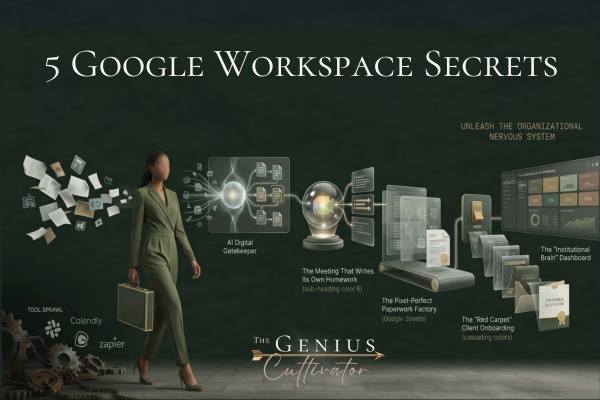
The AI Digital Gatekeeper (Your Low-Touch Inbox)
The average knowledge worker loses two hours a day to the administrative burden of manual email management. Through Agentic Orchestration, you can replace reactive sorting with a proactive notification system. Using Workspace Studio, we build a 24/7 digital gatekeeper that utilizes Gemini to read and triage incoming messages based on intent. It doesn’t just label; it extracts metadata like due dates and drafts 80% of your replies before you even sit down. This shift allows you to breathe, starting your day with a structured digest in Google Chat rather than forty unread messages.
The average knowledge worker loses two hours a day to the administrative burden of manual email management.
The Meeting That Writes Its Own Homework
Meetings are traditionally "disposable" events where decisions evaporate the moment the call ends. By activating the "Take notes for me" feature in Google Meet, you transform these sessions into data-generating assets. The system generates a structured summary and automatically extracts "Next Steps," syncing them directly into Google Tasks. This eliminates the delay between a decision and its execution. More importantly, it allows you to be fully present in the room, knowing the "nervous system" is capturing the brilliance and updating your interaction logs in the background.
The Pixel-Perfect Paperwork Factory
You can retire expensive subscriptions like PandaDoc or Adobe by turning Google Sheets into a precision generation engine. This "Paperwork Factory" runs on an enterprise-class 12-tab foundation—including relational tabs for your Catalog, Clients, and Sales Responses. By mapping this Master Data to pixel-perfect templates, you create an automated assembly line. With one click, the system pulls your specific SKUs and client details to produce personalized PDFs, moving document creation from a manual bottleneck to a background process that executes in seconds.
The "Red Carpet" Client Onboarding
First impressions often suffer under the weight of manual checklists. The "Client Command Center" replaces this friction with self-provisioning infrastructure. The magic happens through a single status change: moving a lead from "Prospect" to "Won" in your Master Sheet. This triggers a chain reaction that prepares the business for the client: the system auto-creates structured Shared Drives, provisions a dedicated Google Chat space, and issues a personalized welcome pack. Your client receives a "red carpet" experience while you stay focused on high-level strategy.
The "Institutional Brain" Dashboard
Communication in external tools like Slack is often "violent" and "busy," scattering context across disconnected channels. The "Institutional Brain" is a unified dashboard in Sheets that serves as the relational glue for your business. It aggregates triage data, task health, and financial logs into one Master View. By utilizing Google Chat’s inline threading and side-panel context, your team can collaborate directly inside the documents themselves. This replaces the "Where is that file?" chatter with absolute operational clarity and a single source of truth.
Conclusion: Beyond the "Cage" of Tool Sprawl
Fragmentation is more than a financial drain; it is a tax on your focus and your future. When your systems are unified, you stop being a tool collector and start being a system architect. Reclaiming your time is the first step toward true scaling.
Is your current tech stack helping you grow, or is it a cage of your own construction?