Why Your Brilliance is Your Business’s Biggest Liability: 5 Shifts to Scale Beyond Yourself
In the early days of a company, your hustle is the engine.
Your ability to solve the hardest problems and move the fastest is what built the foundation. However, as you scale, this "heroic" approach becomes the "Founder’s Bottleneck." If you spend your day firefighting small tasks and acting as the single point of success, you aren't leading; you’re just an overpaid assistant.
The reality check is simple: if the business stops when you stop, you haven’t built a company; you’ve built a cage. To scale, you must transition from a "Technical Specialist"—the person who does the work—to an "Organizational Architect." This shift requires you to stop being the "doer" and start being the designer of systems and the mentor of people.
Here are the five shifts required to reclaim your time and build a business that thrives without your constant labor.
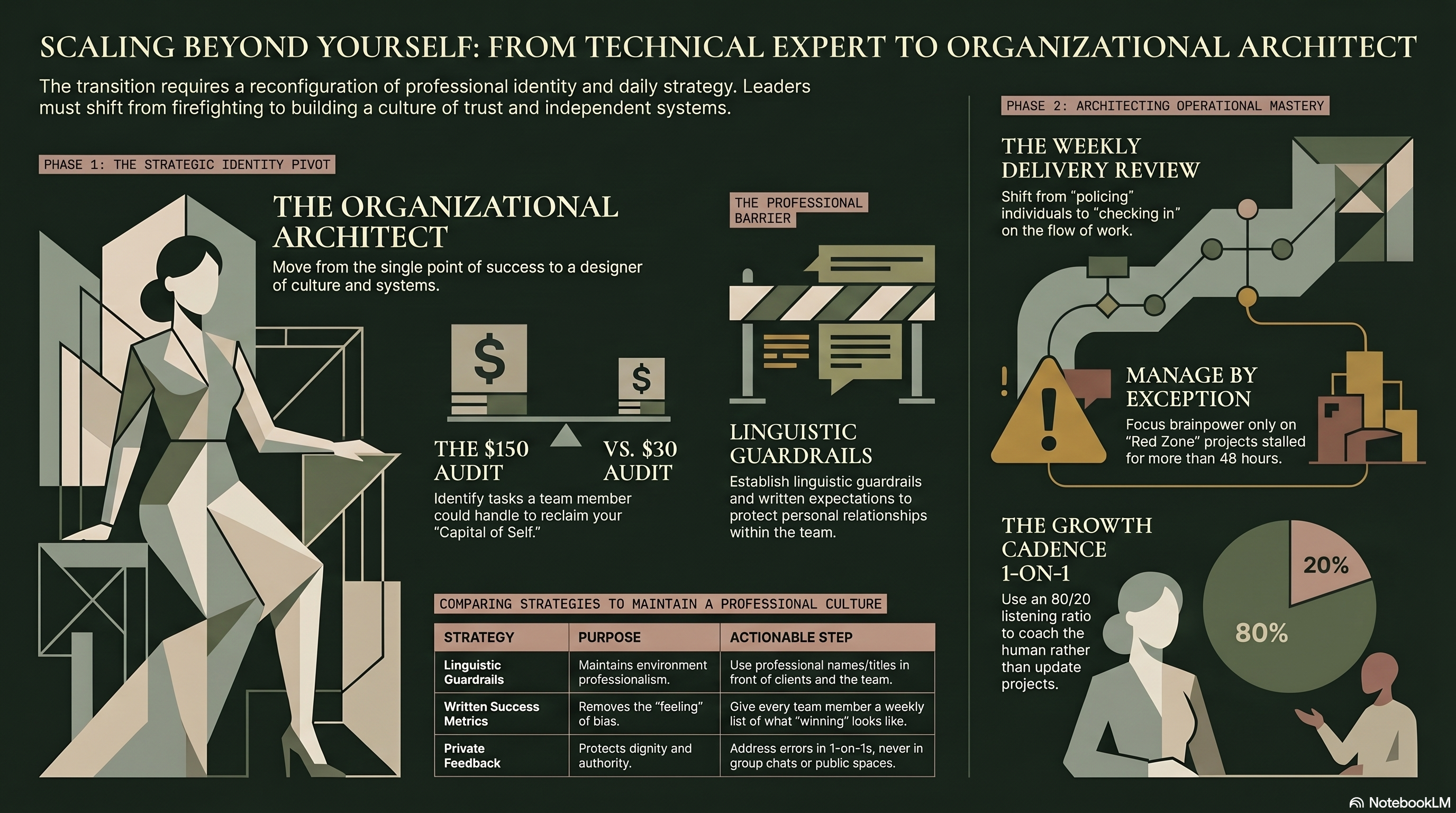
1. Stop Writing Checks to Stay Comfortable (The $150 vs. $30 Audit)
Founders often cling to routine tasks like formatting spreadsheets or chasing signatures because they feel "safe." You know you can do them perfectly, and they provide a momentary sense of accomplishment. But as an Architect, your primary asset is your Capital of Self—your time, focus, energy, and cognitive load.
When you do $30-per-hour work, you are effectively burning your most valuable resource.
The Reality Check: "If your time is worth $150/hour to the business, but you spent 10 hours doing $30 tasks, you effectively wrote a check for $1,200 to stay comfortable."
To break this cycle, audit your week. Identify any task that could be handled by a team member with just15 minutes of training. Your goal is to systematically move these tasks off your plate permanently, protecting your cognitive peak for the high-level system design that actually grows the business.
2. The "Too Nice" Trap in Family-Integrated Businesses
Hiring friends or family provides a foundation of trust, but it often leads to the "Too Nice" trap. Leaders frequently downplay their authority to avoid appearing "bossy," which creates ambiguity and resentment. To protect your relationships, you must lead with "Love and Logic" by establishing a Professional Barrier.
The key is the "Flipped Script" conversation—a proactive move to redefine the relationship for this new chapter.
What to say: "We’ve worked together closely and our personal relationship is so important to me. That won’t change. What is shifting is that I’m now responsible for the performance of the whole team. To be fair to everyone, I need to wear a 'Manager Hat' during office hours. I need your help in keeping our work feedback separate from our personal lives so we can keep our friendship safe outside of here."
To reinforce this, implement Linguistic Guardrails:
Professional Identity: Use first names or professional titles during office hours and in front of clients; save nicknames and inside jokes for happy hour.
The Venting Boundary: Never vent about the business or other employees to friends who report to you.
The Dinner Table Rule: Work issues stay at work; do not discuss office conflicts during family gatherings or personal time.
3. The "One Screen" Protocol for Hybrid Equity
In a hybrid environment, "Proximity Bias" is a silent killer of culture. It is the unconscious tendency to give more credit and information to the people you see in person, creating an "inner circle" in the office and an "outer circle" at home.
As an Architect, you must design a workspace where "geography is irrelevant to contribution."
The "One Screen" Protocol is your primary tool for visual equity. If even one person joins a meeting remotely, everyone must join from their own laptop screen, even if they are sitting in the same room. This ensures:
Every voice carries the same audio weight.
Every facial expression is visible to all participants.
The "hallway huddle" is eliminated, ensuring no one is a mere spectator to the mission.
4. Manage the Exception, Not the Status
The Weekly Delivery Review should not be a policing session where you check up on people. Instead, it is a session to check in on the flow of work. Don't waste time reviewing projects that are moving perfectly; manage by exception.
Implement the48-Hour Rule: any project with no activity for two days enters the "Red Zone." Use these specific mentorship questions to clear the path:
Stalled Momentum: "I see this hasn't moved in two days. Is there a piece of information we're waiting on from the client, or is there a technical hurdle I can help you solve?"
The Final Push: "What is the one thing that could derail this delivery by Friday? Do you have the capacity to cross the finish line, or do we need to shift resources to support you?"
The First Impression: "Have our newest clients felt 'the hug' from our brand yet? Do they know exactly what happens next, or are they sitting in silence?"
5. The "Can’t vs. Won’t" Performance Diagnosis
When a team member underperforms, you must diagnose the root cause before acting. Addressing a "Skill Gap" with a "Will Gap" solution creates friction and kills morale.
The Skill Gap (Can’t):They lack the tools or training. Your role is Teacher. Provide the templates or instructions they need.
The Will Gap (Won’t):They have the skills but are bypassing the protocol. Your role is Leader. You must set a firm, compassionate boundary.
To address these issues without destroying dignity, use the "I Noticed" Conversation anatomy:
The Observation: Start with a neutral fact. "I noticed that the last three reports took 72 hours to complete, rather than our 24-hour standard."
The Heart: Explain the "Why." "I know you care about our clients feeling supported, and I’m worried this delay causes them stress."
The Curiosity: Invite them in. "Can you help me understand what's making that part of the process clunky for you?"
The Partnership: Build the path forward. "What is one resource I can provide to get us back into that 24-hour window by next week?"
Conclusion: From Hero to Multiplier
True leadership is a relay race. Your success is not measured by how fast you run while carrying the baton, but by how well you prepare the next runner to take it from you. When you move from solving every problem yourself to coaching your team on how to think through problems, you stop being a bottleneck and start being a Multiplier.
As an Organizational Architect, you are building a culture where systems thrive because of your vision, not just your labor.
Article written by Notebook LM, based on the book "Scaling Beyond Yourself" by Kris Fleming, The Genius Cultivator