Did You Make the Worst Choice?
As you may recall from our last newsletter, in Big Money, The Long Game, or Feeling Human
we dealt with a time-sensitive dilemma that forces us to choose between three competing priorities.
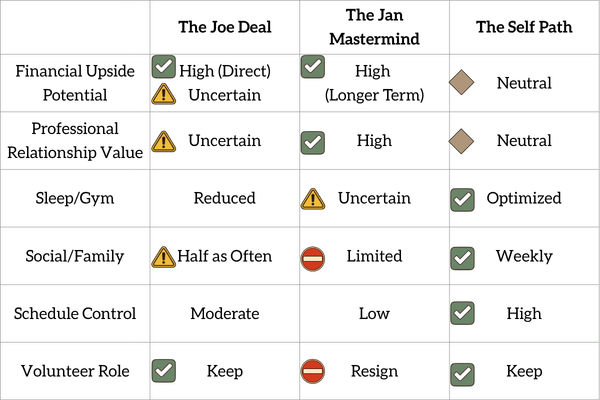
There was a choice between an immediate, potentially highly lucrative business deal with an acquaintance named Joe (The Hustle), a significant, long-term professional growth opportunity via a limited-enrollment Mastermind with a respected instructor named Jan (The Growth), or the simple path of self-care and prioritizing time with loved ones (The Recharge). The Mastermind application window is closing, and Joe's deal requires quick action, meaning a choice for one path means immediately missing the opportunity for another.
Here is the chart to recap:
I asked readers to respond to let me know what they would choose, and responses were evenly split! ⅓, ⅓, ⅓. One sneaky respondent tried to pick two, despite clear instructions, and I think it’s highly important to discuss why that is actually the worst possible choice. I suspect that’s the essence of what most of us are trying to do each and every day.
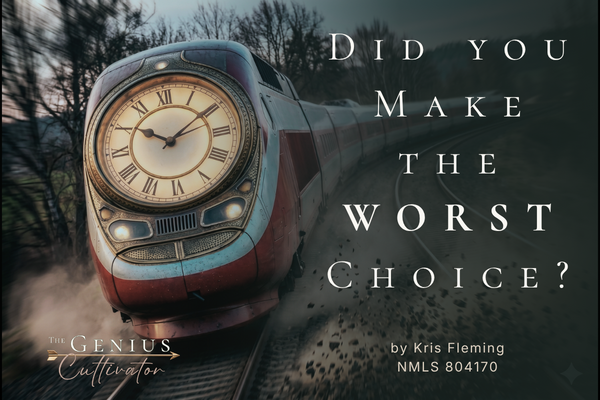
Choosing multiple paths is like trying to drive a high-speed train while stopping at every small station on the way. You lose momentum, and the energy cost skyrockets. A train moving 100 miles without stopping reaches its destination in two hours. A train that stops at every station for 10 minutes takes four hours and uses up to 2.5 times more energy per mile, even when the total distance is the same.
The train that does not make stops on the way benefits from using the massive energy to get started only once, and maintains momentum all the way to its destination. The train that stops at every station must use that massive input of energy to “get started” over and over and over again. Just as soon as it gains sufficient momentum to be moving swiftly along, it stops again.
Your Capital of Self is a term I use to encompass your time, your energy, your cognitive load, and your well-being into one singular concept. Just like your financial capital, at any moment in time, your Capital of Self is a finite resource. You can’t simply will more of it into existence. But you can strategically support it and protect it.
Most of us in the niche of this readership manage and strategize money very carefully. We spend a lot of time learning about money, how to use it, how to make it grow, how to protect it, and how to keep as much of it as possible.
Without sufficient management of your Capital of Self, you’re using at least 2.5 times the energy and resources to reach the same result. This is what happens if you try to manage Joe's deal (The Hustle) while also starting Jan's Mastermind (The Growth): you are forcing your internal engine to stop and start repeatedly. And we didn’t even yet talk about how you can take 12 two hour trips in a 24 hour period, but only 6 four hour trips. The math ain’t mathin’ for ya.
In our next installment, we’ll continue evaluating our options. For now, I hope you can see that the worst choice is to choose more than one. I ask again: which one would you choose? Email me at [email protected] and say “Joe,” “Jan,” or “Me” to let me know.
To be continued...