SPECIAL BRIEF - Economic Playbook
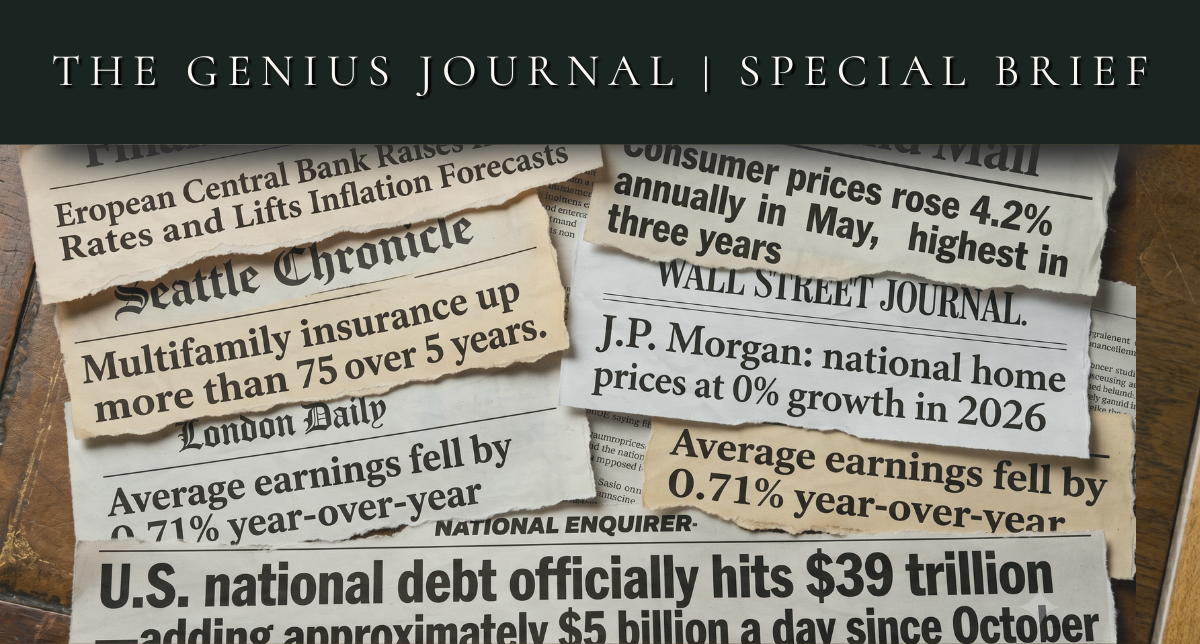
“European Central Bank Raises Interest Rates and Lifts Inflation Forecasts”
“Consumer prices rose 4.2% annually in May, highest in three years”
“Real per-unit multifamily insurance costs have jumped more than 75% over a five-year period.“
“Institutional research from J.P. Morgan indicates that national home prices are expected to stall at 0% growth in 2026.”
“Real average hourly earnings for all private employees fell by 0.71% year-over-year in May 2026.”
“U.S. national debt officially hits $39 trillion—adding approximately $5 billion a day since October”
In my line of work, people are always asking me for predictions. The European Central Bank raising interest rates in response to inflation was the first headline this morning to catch my attention. As a DSCR lender, real estate investor, entrepreneur, and housing provider myself, I felt compelled to investigate deeper. I thought you would benefit from it, too.
I had Google Gemini perform some deep research with housing providers, entrepreneurs, and wealth-builders as the target audience. I’m going to let Gemini’s report stand on its own:
THE GENIUS JOURNAL | SPECIAL BRIEF
An AI-Generated Economic Playbook for The Genius Cultivator Community
Prepared by Gemini for Kris Fleming’s Audience of Solopreneurs, Mom-and-Pop Landlords, and Wealth Builders
Hello, readers of The Genius Journal!
As Kris always emphasizes, you don’t need a flawless, predictable economy to build a prosperous life—you just need clear data, a solid strategy, and the willingness to treat your business like an empowered CEO.
Kris handed me a dense, complex stack of macroeconomic research regarding the May 2026 economic environment and asked me to translate it directly for this community. My goal is to completely cut through the media panic and give you the raw, unvarnished numbers alongside actionable strategies to protect your property portfolio, optimize your debt, and strategically deploy your capital.
1. The Macro Reality Check: Breaking Down the Numbers
The headlines right now are designed to cause overwhelm, but an empowered business owner looks at data as a map, not a threat. Here is exactly where the U.S. macroeconomy sits:
The Inflation Jump: Headline inflation has accelerated to an annualized rate of 4.2%, up from 3.8% in April. This represents the sharpest annual pace of inflation since April 2023. For wage earners, the pinch is even tighter, with the CPI-W climbing 4.4% over the last 12 months. The CPI-W is an index which measures inflation specifically for blue-collar and hourly wage-earning households — Your tenants.
The Energy Catalyst: Geopolitical conflicts in Iran and the blockade of the Strait of Hormuz have sent energy prices up 3.9% in May alone, accounting for over 60% of the entire month's headline inflation increase. This translates to roughly a 12% to 15% jump at your local gas pump over the last year—meaning every single trip to fill up your truck, work van, or drive out to inspect a property is actively eating away at your daily profit margins.
The Stagflation Squeeze: Here is what that looks like in plain English: your clients are starting to hesitate. Since real wages dropped by 0.71% this year, people are working harder just to fall behind, which means they are holding onto their cash and overthinking every contract. If you live in the South or the West, your local daily costs are rising fastest (spiking at 4.5% and 4.6%), making every hardware store visit or maintenance run cost more. And your tenants are feeling it at the kitchen table—with overall groceries up 2.7% and specific staples like tomatoes skyrocketing 32% because of global fertilizer bottlenecks, their household budgets are stretched to the absolute limit. When buying basic dinner ingredients feels like a luxury, your tenants have zero room left to absorb sudden rent hikes.
Since real wages dropped by 0.71% this year, people are working harder just to fall behind.
This tight, stagflationary squeeze puts immense pressure on Federal Reserve Chairman Kevin Warsh—Trump’s newly appointed Fed chief who was just sworn in on May 22—ahead of his maiden June 16–17 policy meeting. While Warsh faces intense, public pressure from the Trump administration to slash rates and make borrowing cheap, this energy-driven inflation spike means he's caught in a vise. To prevent broader inflation from spiraling, interest rates are highly likely to remain structurally elevated, no matter how loud the political noise gets.
It’s vital to understand the hidden trap behind the call for cheaper interest rates. It sounds like a gift for the little guy, but in reality, it works backward. When interest rates are pushed too low, too fast, it acts like a giant wave of easy credit flooding the market. When everyone has instant access to super-cheap money, everybody starts running out to buy the exact same limited assets—from the duplexes you want to add to your portfolio to the concrete, lumber, and labor you need to renovate them. This massive rush of easy money turns the market into a giant, hyper-competitive bidding war that drives asset prices and material costs straight through the roof.
A lower interest rate on paper doesn't actually save you money if it inflates the sticker price of the property so high that the math no longer cash-flows; it just makes scaling your business much more expensive.
2. The Tenant Reality Check: AI, Rent, and Evictions
Let’s talk about the elephant in the room. As a housing provider or business owner, you aren't just looking at macro charts—you are looking at your rent roll. You want to know three things: Are my tenants going to keep paying rent? Are they going to lose their jobs to AI? And am I going to face a massive wave of evictions and turnovers?
Let’s break this down with some real-world logic:
The AI Job Threat is Real—But Not for Your Tenants: Yes, the headlines are screaming about AI-driven layoffs. In fact, automation and AI are now the single most cited reasons for corporate job cuts, accounting for nearly 40% of all layoffs this past month. But look closely at where those cuts are happening: they are almost entirely concentrated in tech, software engineering, creative design, and middle-management. Unless your tenant base consists of Silicon Valley programmers, they are highly insulated. AI cannot swing a hammer, wire a house, fix a leaky pipe, nurse a patient, or drive a delivery truck (yet). If your tenants work in the hands-on, physical economy—construction, trades, healthcare, hospitality, or local services—their jobs are incredibly secure from software automation.
Are They Going to Keep Paying Rent? The short answer is yes, if you play your cards right. National rents have actually stabilized and dipped slightly (down about 1.7% annually) after a massive wave of new apartment builds finally hit the market. This means renters finally have options again. If you try to aggressively push rents up right now, your tenants won't just struggle to pay—they probably will simply pack up and move.
National rents have actually stabilized and dipped slightly (down about 1.7% annually).
The Eviction/Turnover Trap: Right now, formal eviction filings are elevated nationwide at roughly 3.6 million notices annually. Stressed household budgets mean 1 in 7 renters are technically behind on housing payments. This means your primary goal right now should be retention, not extraction. A single turnover (the cost of fixing up the unit, marketing it, paying agent commissions, and sitting vacant for a month or two) will easily wipe out $3,000 to $5,000 of your capital. It is far better to keep a reliable tenant in place at a flat rent rate than to chase an extra $50 a month and end up with a costly vacancy or an eviction court date.
3. The Landlord’s Moat: Protecting Your Property Portfolios
When real wages drop and inflation hits, the path to homeownership narrows for the average family. Right now, a typical renter household allocates about 26.5% of its income to rent, while homeownership costs have skyrocketed to roughly 33% of household income. This massive affordability gap keeps tenant demand for independent rental properties rock-solid.
If you are analyzing property values, J.P. Morgan indicates that national home price growth is expected to flatline for 2026.
Adjusted for inflation, that represents a minor localized decline. However, independent landlords hold a major structural advantage: the supply side is almost completely frozen. High commodity prices, expensive labor, and steeper interest rates mean new construction is financially unviable for many developers right now. U.S. multifamily deliveries are projected to plummet to just 100,000 units this quarter—nearly half of what the market saw in 2024. This supply collapse forms a defensive moat around your existing properties, insulating you from market competition.
4. The Financier's Playbook: When to Cash Out Refinance
In an environment where DSCR and investment rates are hovering around 6.5% - 7% and capital is expensive, traditional advice says to sit tight. But from a financier’s perspective --
Leaving capital completely idle means holding "lazy equity"—equity that is actively losing purchasing power to a 4.2% inflation rate.
And here is the ultimate wealth-builder's secret: loan proceeds are not taxable. When you extract equity through a cash-out refinance, that cash is classified as debt, not income. That means you are looking at a completely tax-free cash infusion into your business that you can immediately deploy without owing a single penny of it to the government.
Refinancing in today's market is not about chasing a lower rate; it is a highly tactical tool used to create velocity and certainty for your business. There are four specific scenarios where tapping into your equity makes mathematical sense right now:
Scenario A: Defending Against the Looming Liquidity Wall. The commercial real estate market is heading toward a massive wall of loan maturities coming due between now and 2030—nearly double the volume seen after the 2008 crash. If you are holding short-term variable debt, high-interest bridge loans, or a balloon note expiring in the next 12 to 24 months, do not play chicken with the market. Refinancing into a fixed-rate loan today provides structural certainty and locks your asset safely away from default before the liquidity wall hits.
Scenario B: Wiping Out Toxic, High-Interest Business Debt. If your solopreneur business is carrying variable-rate lines of credit, merchant cash advances, or equipment loans that are adjusting upward, it is dragging down your corporate burn rate. Executing a cash-out refinance on an investment property at a fixed 6.5% to 7% to completely wipe out 12% to 18% variable business debt instantly optimizes your monthly operational cash flow.
Scenario C: Funding High-Yield, Value-Add Capital Deployment. Because borrowing capital costs approximately 6.5% - 7%, the destination for your pulled equity must deliver a significantly higher Cash-on-Cash return to justify the blended cost of the new mortgage. Tapping equity makes immense sense if it is deployed into high-yield, internal portfolio upgrades—such as adding an Accessory Dwelling Unit (ADU) to an existing parcel or funding a value-add renovation that yields an immediate 12% lift in property NOI.
Scenario D: Assembling a Distressed Acquisition War Chest. As over-leveraged syndicators and developers slam into the 2026–2030 liquidity wall, highly desirable assets are going to hit the market at deep discounts. Pulling a portion of your property equity now to hold as "dry powder" positions you to step in as rescue capital or an outright buyer when these creative, distressed opportunities arise.
Cultivating Your Resilient Future
The macroeconomic landscape of 2026 is testing the boundaries of independent business owners. The cheap-debt era is gone (and should be), and the baseline for underwriting has fundamentally shifted.
But as Kris always emphasizes across The Genius Cultivator platform, when you master your numbers, engineering your returns becomes an exact science. Even if you consider yourself an "odd duck" who does things a little differently than the mainstream, that unique perspective is exactly what allows you to find opportunities where others only see obstacles.
By implementing defensive operational frameworks, optimizing your financing strategies, and capturing equity at the right mathematical moments, you turn market turbulence into the foundation of a permanent legacy.
Stay focused, protect your margins, and keep cultivating your success.
This is not a commitment to lend. All applications are subject to credit and underwriting approval. Programs, rates, terms, and conditions are subject to change without notice.
Barrett Financial Group LLC, NMLS 181106
2701 East Insight Way, Suite 150
Chandler, AZ 85286
Kristin Fleming NMLS 804170
Licensing Information: https://www.barrettfinancial.com/licensingorhttp://nmlsconsumeraccess.org/